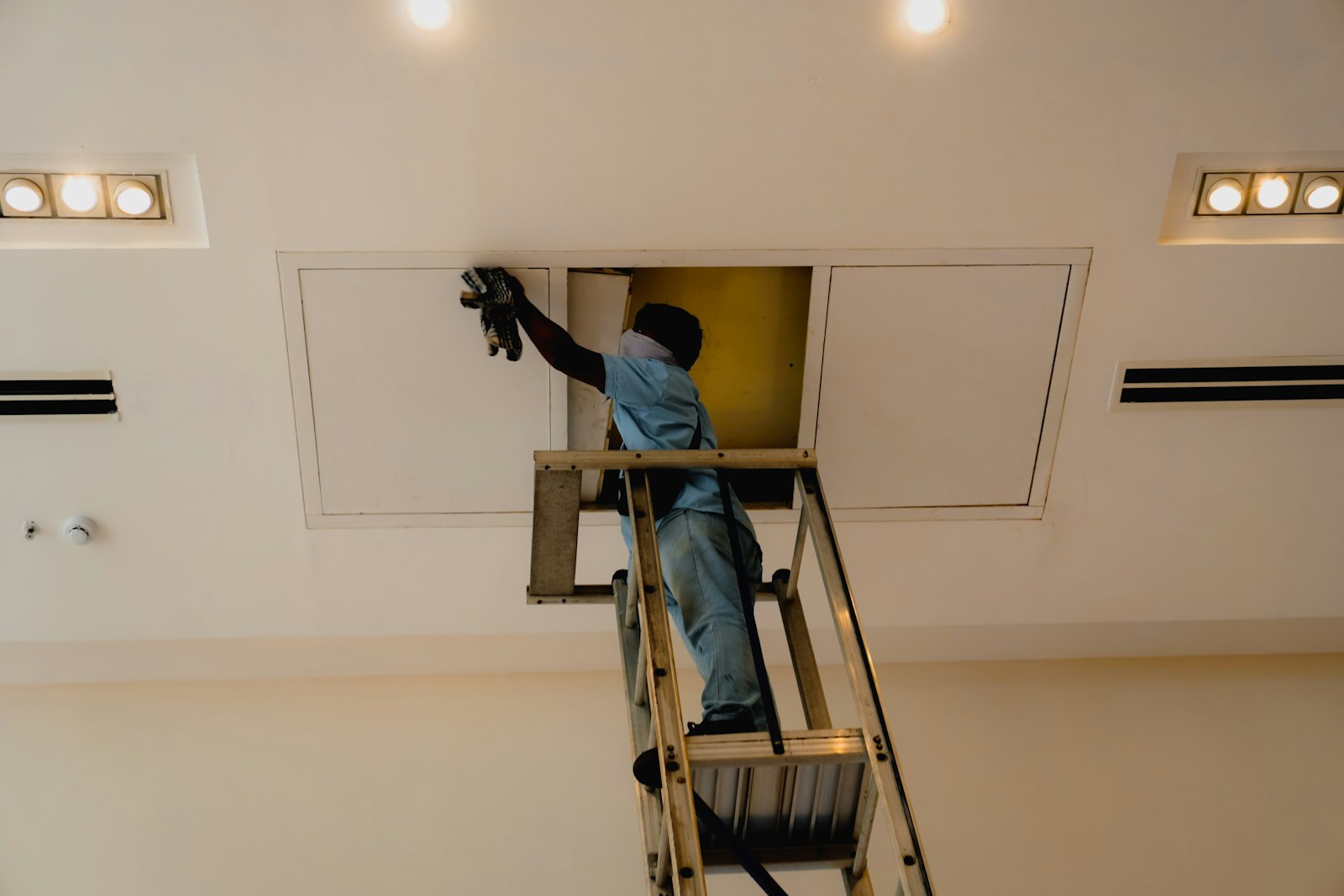
Service
Ceiling Repairs
Ceiling repairs across West Molesey and Surrey: sagging lath and plaster, water damage, cracks and collapses — assessed honestly, made safe quickly, and repaired to match. Victorian ceilings to modern plasterboard, from patch to full replacement.
By the Surrey Plasterers team
Plastering & rendering specialists · West Molesey, KT8
Ceilings fail differently from walls, and more dangerously: a ceiling that lets go does so downwards, onto whatever and whoever is underneath. Most of the ceiling work we see across Surrey falls into three families — original lath and plaster ceilings in Victorian and Edwardian houses reaching the end of their adhesion, water damage from leaks and overflows above, and ordinary cracking in modern plasterboard ceilings that looks alarming and usually is not.
Lath and plaster deserves respect and understanding in equal measure. Those ceilings were built by pushing wet lime plaster up between closely spaced timber laths so it squeezed through and curled over — the "keys" that hold the whole ceiling up. A century of vibration, leaks and loft traffic snaps keys one by one, and when enough fail in one area the plaster hangs on the laths by habit alone. That is what a sag is: a ceiling announcing its intentions. The judgement call — repair the area, overboard the ceiling, or pull it down and start again — is exactly that, a judgement call, and we make it by inspecting from above wherever the loft allows, not by guessing from below.
Water damage is the other regular. The stain is the headline, but the questions that matter are whether the plasterboard has lost its strength, whether the insulation above is waterlogged (and pressing its weight on the board), and whether the leak is actually fixed. We repair in the right order: leak stopped, ceiling dried, damaged material cut out or overboarded, stain-blocked and refinished — and for insurance claims we photograph everything and provide a written scope of works, which is precisely what loss adjusters ask for.
Is a sagging ceiling dangerous?
A sagging lath and plaster ceiling should be treated as a live risk: the sag means the plaster keys holding it to the laths have broken, and a section can come down without further warning. Keep people from under it, don't prod it, and get it inspected promptly — same-day if it is dropping visibly.
The severity test is movement. A slight historic belly that has not changed in years is common in period ceilings and can often be stabilised or overboarded in ordinary time. A sag that has appeared recently, grown, cracked at its edges or started shedding flakes is a ceiling in motion — old lime plaster is astonishingly heavy, a square metre can weigh 25 kilos or more, and furniture and children do not negotiate with it. If part has already fallen or is hanging, treat it as a ceiling collapse emergency and call us rather than waiting for a quote slot.
We inspect from above through the loft or floorboards where access exists — the only honest way to see how many keys survive — and from below with a straightedge and gentle pressure. Then you get a plain verdict: stable and monitorable, repairable, or down it must come. What we will not do is screw a cosmetic patch over a ceiling that is telling everyone it wants to leave.
Repair, overboard or replace: what does your ceiling need?
Repair when damage is local and the rest of the ceiling is sound — a patch, a water-damaged section, a crack. Overboard when the surface is failing broadly but the structure above is good: new plasterboard screwed through to the joists, then skimmed. Replace — pull down and re-board — when lath and plaster has failed extensively.
Overboarding is the workhorse of ceiling renovation and usually the best value: the old ceiling stays up (no demolition, a fraction of the dust), new boards go through it into the joists so the fixing is structural, and a skim gives a flat new surface — typically £350–£600 a room. It suits tired-but-attached lath and plaster, crazed Artex (tested first — more below), and stained ceilings past cosmetic rescue. Its limits are honest ones: it adds a little weight and loses 15mm or so of height, and it must never be used to trap an actively failing ceiling, because screws through loose plaster just suspend the problem above your head.
Full pull-down and re-board is the right call perhaps one time in five: extensive key failure, historic water saturation, or sags across most of the room. It is dusty, disruptive, and we say so up front — rooms sheeted and sealed, debris bagged and gone the same day — and what you get back is effectively a new ceiling, flat and good for another century. Where original ornate cornice exists, we work carefully to preserve it, which is half the craft in period homes.
How do you repair a water-damaged ceiling?
In strict order: stop the leak, let the ceiling dry fully, then repair — cut out and re-board sagging or soft sections, or skim where the board survived — and always apply a stain-blocking primer before repainting. Skip the stain block and the brown ring bleeds through every coat of emulsion you ever apply.
The drying stage is where patience pays. Plasterboard that got briefly wet and dried flat often keeps its strength and needs only the stain treated and the surface reskimmed. Board that stayed wet — under a slow tank leak or a long-unnoticed drip from pipework above — loses its rigidity, bellies between joists and must come out, along with any sodden insulation sitting on top of it. We test with a moisture meter rather than by eye, because a ceiling can look dry weeks before it is.
For insurance claims we make the process easy to evidence: photographs of the damage before and during the work, a written scope and quotation that a loss adjuster can process without a second visit, and the repair sequenced so the leak fix is documented first. Once repaired and skimmed, the finish is blended so the repair disappears — the standard for a patch-and-skim is that nobody can point to where it was.
What do ceiling repairs cost in Surrey?
Small ceiling patch repairs start from around £120. A full ceiling skim runs £200–£350, overboarding and skimming a whole ceiling £350–£600, and pulling down a failed lath and plaster ceiling and re-boarding sits above that, priced by room size and access once we have seen it.
Water-damage repairs span the whole range depending on how much board and insulation must be renewed — a kettle-sized stain with sound board is a patch-and-stain-block day at the bottom of the scale, while a saturated bathroom ceiling with sodden loft insulation above is a strip-out. Lath and plaster work prices on the inspection: stabilising and overboarding a Victorian ceiling costs materially less than taking it down, which is one more reason to call before the ceiling makes the decision itself.
Every job gets a fixed written quote, and for insurance work the quote doubles as the scope document your insurer needs. One honest warning about cheap fixes: a skim over a failing ceiling is the most expensive £250 you can spend, because you pay again — plus the redecoration — when the real problem resurfaces through it.
Cracks in the ceiling: cosmetic or structural?
Most ceiling cracks are cosmetic: hairlines along plasterboard joints, shrinkage around newer work, and crazing in old surfaces. The ones that warrant attention are cracks wider than about 3mm, cracks paired with sagging, stepped or spreading cracks, and any crack that reopens repeatedly after proper filling.
The geography of the crack tells the story. Long straight lines are almost always board joints flexing — an adhesion and movement issue, fixed permanently by taping, filling and skimming rather than by chasing them with filler every spring. A crack tracing a single line across mid-ceiling often follows a joist; if the floor above bounces as someone walks, the joist is flexing and the crack will return until the movement is addressed. Map-like crazing on an older ceiling is the finish ageing, not the structure — and if that crazed texture is Artex applied before 2000, it may contain asbestos, so it gets lab-tested before anyone sands or scrapes; our Artex removal page explains the safe routes.
Genuine structural cracking — wide, stepped, growing, or matched by cracks in the walls — is rarer and bigger than plastering, and we say so when we see it: a structural engineer looks first, we repair after. Being the trade that tells you that honestly is, we find, why people call us back for the next thirty jobs that are just plaster.
What’s included
- Sagging ceilings made safe
- Water damage repairs
- Lath & plaster expertise
- Patch, overboard or replace
When you need this
- A ceiling is visibly sagging, bellying or has dropped debris — keep clear and call today
- A leak or overflow from above has left stains, soft board or a bulge
- A brown water stain keeps bleeding through every coat of paint
- Cracks along board joints or across the ceiling keep reopening after filling
- An original lath and plaster ceiling in a period home needs honest assessment
- An insurer needs a written scope and photos for a ceiling damage claim
How it works
1. Make it safe
For sagging or collapsed ceilings we prioritise the visit, cordon the area, and remove anything hanging — stabilising first, paperwork second.
2. Inspect properly
From above via the loft where access exists, and from below with a straightedge and moisture meter. The verdict — repair, overboard or replace — comes from evidence.
3. Fixed written quote
Scope, method and price in writing. For insurance claims, photographs and a scope document formatted for your insurer and their loss adjuster.
4. Strip or prepare
Damaged material cut back to sound edges — or the full ceiling down where that's the honest call — with the room sealed, sheeted and debris bagged as we go.
5. Board and skim
New boards screwed through to joists at correct centres, joints scrimmed, then a two-coat Thistle skim trowelled flat — stain-blocked first wherever water was involved.
6. Blend and hand over
Edges feathered so the repair disappears, cornice and coving made good, floors cleaned, and drying and mist-coat guidance left in writing.
Ceiling Repairs prices in Surrey — from
Indicative starting prices including VAT. The exact price depends on the property, system and parts — call for a firm, fixed quote.
Small ceiling patch repair
From £120
Local damage cut out, boarded, skimmed and blended flush
Full ceiling skim
From £200
Typically £200–£350 — the refresh for tired but sound ceilings
Overboard & skim whole ceiling
From £350
£350–£600 — the usual best value over failing surfaces
Water damage repair & stain block
From £150
After the leak is fixed — includes moisture checks and stain-sealing
Lath & plaster assessment & repair
From £150
Inspected from above where possible; pull-down and re-board quoted per room
Surrey Plasterers vs the alternatives
Honest comparison against general builders and the national franchises. Pick what works for you — but pick with the facts.
| Criteria | Surrey Plasterers | Builder / franchise |
|---|---|---|
| Sagging ceiling verdicts | Inspected from above, judged on evidence, made safe first | General builders screw a patch over it and move to the next trade |
| Lath & plaster knowledge | Period ceilings handled on their own terms — keys, laths, cornice | Nationwide firms quote pull-down because it's the only line on the menu |
| Water stains | Moisture-metered, dried, stain-blocked, then refinished | Painted over wet — the ring is back by the next bank holiday |
| Insurance claims | Photos and a written scope your loss adjuster can approve first time | A verbal price and a shrug when the insurer asks for detail |
| Old Artex ceilings | Pre-2000 texture lab-tested before anything is disturbed | Sanded off on a Saturday — the risk nobody should take |
In Surrey
Local picture
Ceiling work maps precisely onto Surrey's housing history. The Victorian and Edwardian terraces of Surbiton, Kingston and Thames Ditton keep us in lath and plaster — sags, snapped keys and ceilings that have carried a century of loft traffic. The 1930s semis of Molesey, Walton and Hersham mix early plasterboard with Artex applied in the 1970s, which means testing before touching. Esher, Cobham and Oxshott bring larger homes with water-tank leaks over bedroom ceilings and ornate cornice worth saving. And the newer stock around Woking supplies the modern classics — cracked board joints, popped screws and bathroom leaks through kitchen ceilings, all repairable and all quoted in writing from West Molesey.
Available across Surrey
FAQ
Ceiling Repairs — your questions, answered
My ceiling is bulging — what should I do right now?+
Can a sagging lath and plaster ceiling be saved?+
A ceiling repair was patched before and cracked again. Why?+
How soon after a leak can the ceiling be repaired?+
Do you deal with insurers directly?+
Is the crack between my ceiling and the wall a problem?+
My ceiling has Artex — can you just skim over it?+
Related services
Plastering & Skimming
Smooth, flat walls and ceilings — one-room skims to whole-house re-plasters, quoted in writing.
ReadArtex Removal & Skimming
Textured ceilings flattened safely — asbestos-aware skim-overs, overboarding or removal, done right.
ReadCoving & Cornice
Plaster coving fitted, period cornice matched and restored, ceiling roses supplied and fitted.
ReadDamp & Re-plastering
Re-plastering after damp treatment — salts hacked off, walls rebuilt to the specialist's spec.
ReadDry Lining & Plasterboarding
Dot & dab, stud partitions and tape & joint — fast, straight walls built with the right board.
Read
Need a plasterer or renderer?
One number for skimming, rendering, ceilings and urgent make-safe work — and a real person answers it.